
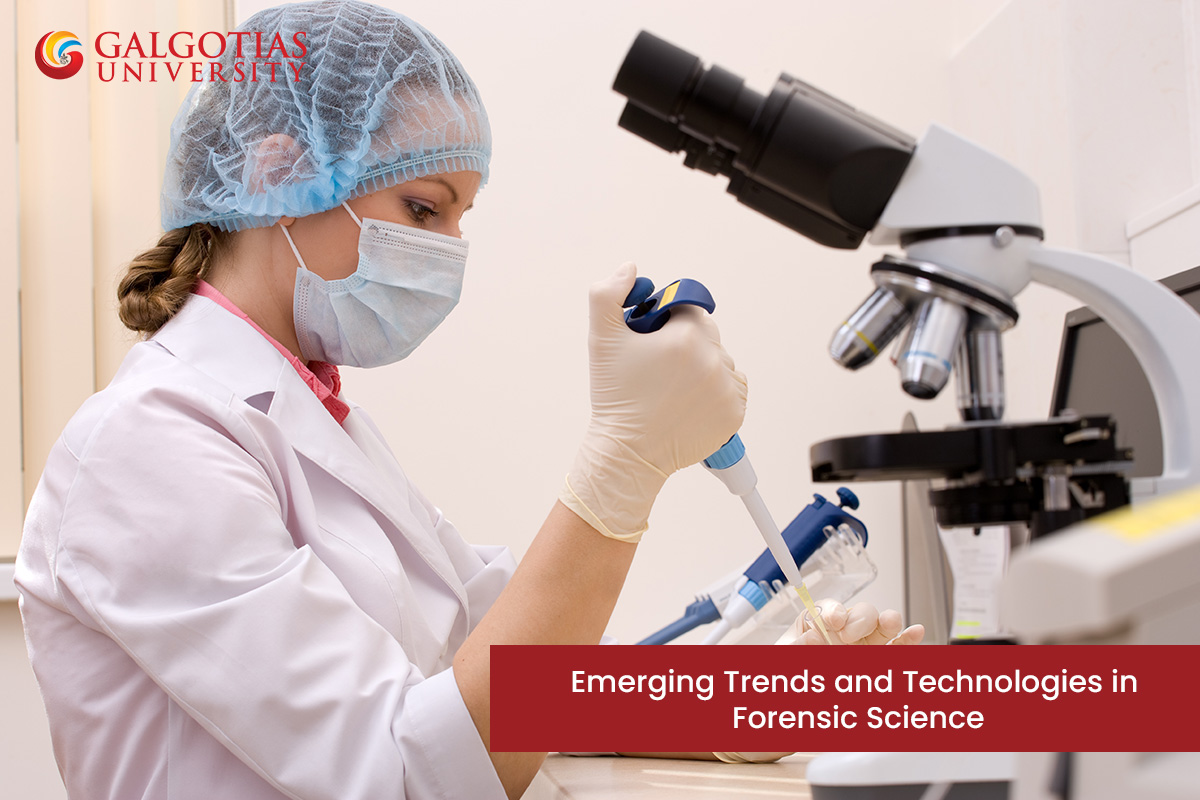
Emerging Trends and Technologies in Forensic Science
Forensic science is still one of the most important parts of the whole criminal justice system, which is the most dependent on technology, and that is the reason why it has been through the most dramatic technological upgrades in the last couple of years. As crimes are becoming more and more sophisticated, forensic experts are turning to quite complex and very advanced methods and technologies, which in turn help them reveal the evidence with great accuracy, and they do it in a very short time. One of the best colleges in Greater Noida is Galgotias University, which gives a very important place to the quality of education and research in the field of forensic sciences. The M.Sc. in Forensic Science at Galgotias University in Noida provides students with state-of-the-art instruments and methods that are leading the way to future crime detection and justice delivery.
Emerging Trends in Forensic Science
Artificial Intelligence and Machine Learning
One cannot imagine a forensic investigation without the help of AI and machine learning. These are the two technologies that analyse the huge datasets (which in this case could be digital communication records, biometric data, etc.) at lightning speed, and also, investigators are enabled to discover the patterns and unusual occurrences within these data in almost no time. In connection with this, the aided AI facial recognition and voice analytics are being equipped step by step to make identification possible even in short and not-so-high-quality video and audio recordings; thus, the elimination of human error is ensured, and the solving of cases is made faster.
Next-Generation DNA Sequencing
Next-Generation Sequencing (NGS) has changed the DNA world practically. In essence, it has made it possible for a forensic lab to sequence a complete genome quickly and accurately. NGS plays a significant role in all these processes: as a primer in differentiating between mixed DNA from several individuals; when simplifying the research process of minute and complex source materials; and when even predicting physical traits such as eye colour and eating habits. Just like that, forensic orders receive an unlimited deal – they don't solve cases, they 'unsolve' ones.
Digital Forensics and Cybercrime Investigation
As cybercrime has become a significant concern, digital forensics has become central. Just to mention a few of the recovery processes, data can be deleted, encrypted, or corrupted, yet the forensic expert is able to retrieve the information, no matter if it existed on a smartphone or cloud storage. Tracking of online activities is done by the use of the latest programs; as a result, even the tiniest social media interaction is revealed, and digital footprints that would otherwise be overlooked become crystal-clear trails to fraud, identity theft, and cyberterrorism cases. Besides that, the Internet of Things (IoT) can also be a source of difficulties and benefits in the process of collecting digital evidence from smart devices like wearables and home assistants.
Advanced Imaging and Virtual Autopsies
Imaging technologies, AI-driven multi-detector computed tomography (MDCT), and virtual autopsies have been the major factors a few days ago, which have led to a revolution in forensic pathology. These novelties allow accuracies and adequacies of diagnostics without any invasive interventions; as a result, the forensic doctors' work is made easier and at the same time, they are more accurate in identifying the cause of death and even the time of death. Besides the imaging process automation, the AI integration also impacts the achievement of results that are both reproducible and reliable – an issue that is of great importance when delivering forensic evidence in courts.
3D Crime Scene Reconstruction
Reconstruction of crime scenes in 3D makes it possible for investigators to have a first-hand experience of the spatial relations and the positions of the evidence. They can also take help from the experts in software engineering and the laser scanning sector to produce very advanced models for use in courtrooms, which, in turn, simulate various investigative scenarios. One issue that is resolved through this means is the quite accurate and clear way ushered in by investigations.
Sustainable Forensics and Green Practices
The new issues the forensics field will deal with are how to perform the work in a sustainable and ecologically friendly manner. Advanced materials with a low environmental impact and the use of green laboratory techniques are a part of the changes that reflect a commitment to sustainability without sacrificing forensic precision.
Galgotias University: Pioneering Forensic Sciences Education
Galgotias University, known as one of the best engineering colleges in Uttar Pradesh and a top college in Greater Noida, provides for the forensic sciences a robust program that effectively merges the university. M.Sc. in Forensic Sciences syllabus of the university puts more on-the-job experience on the use of AI, digital forensics, DNA technologies, and forensic imaging besides the conventional methods. With all the resources available, great partnerships & research interactions, Galgotias University creates the best talent for the future of the field of forensic science.
Conclusion
The Forensic Science field keeps on changing very fast with the inclusion of Artificial Intelligence, Advanced DNA Sequencing, Digital Forensics, and 3D Reconstruction technologies. Students who are eager to be the best in the field and are willing to get the best knowledge and practical skills should consider joining top M.Sc. inForensic Sciences colleges in Noida, like Galgotias University. Being one of the best engineering colleges in Uttar Pradesh, the dedication of Galgotias University to the most advanced education ensures its alumni to be the leaders of the future of forensic investigations and thereby make eco-friendly contributions to justice and public safety.