Expert talk on “Generative AI: Redefining Creativity and Innovation”
Event Date and year -26 September,2025
Event brief description –
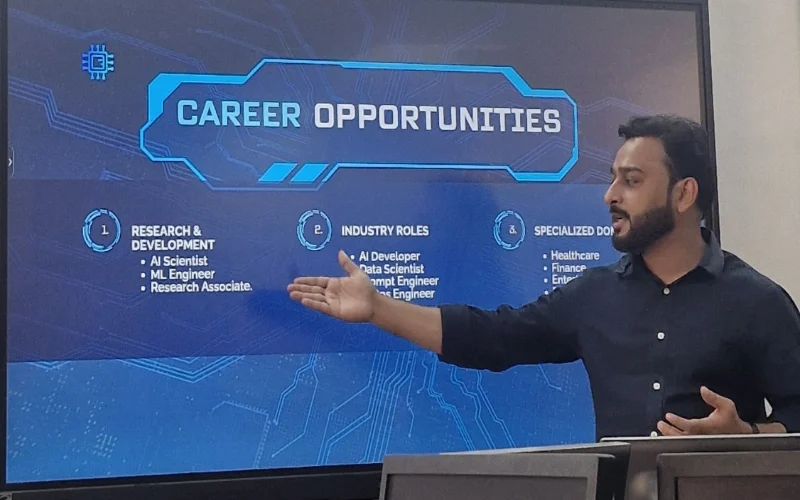
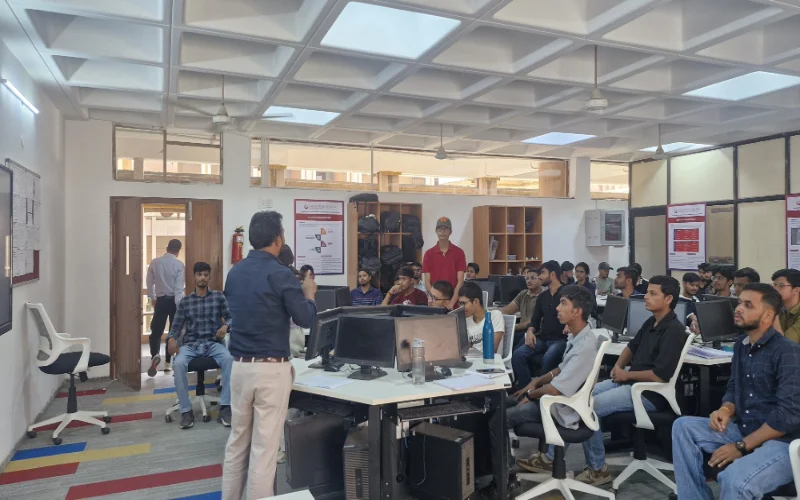
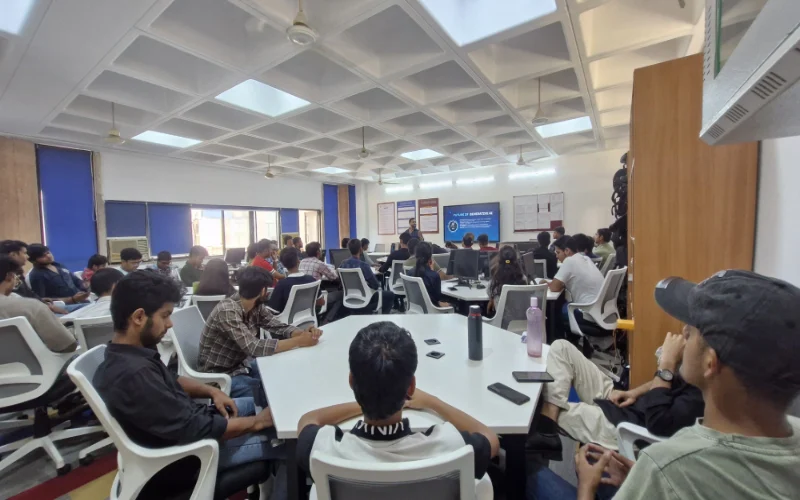
The Department of Computer Science and Engineering, Galgotias Polytechnic, Galgotias University organized an expert talk on “Generative AI: Redefining Creativity and Innovation” on 26th September 2025 at Campus-1, Room B207. The session was delivered by Mr. Abdul Khan, Former IBM Developer and AI Expert, who shared his valuable knowledge and experience with the students.
During the talk, Mr. Khan highlighted the fundamentals of Generative AI, its real-world applications, and how it is transforming industries by redefining creativity and innovation. He also discussed future opportunities in AI-driven domains, inspiring students to explore and prepare for emerging career paths in technology.
The session was highly interactive, with students actively participating and asking insightful questions. It proved to be an enriching learning experience, broadening the understanding of students about cutting-edge technologies and their impact on society.
Event Detailed Description-
The Department of Computer Science and Engineering, Galgotias Polytechnic, Galgotias University successfully organized an expert talk on “Generative AI: Redefining Creativity and Innovation” on 26th September 2025 at Campus-1, Room B207. The invited expert for the session was Mr. Abdul Khan, Former IBM Developer, AI Specialist, and Generative AI Practitioner with six years of professional experience in the field of Artificial Intelligence.
The event began with an introduction to the significance of Generative AI in the current technological landscape. Mr. Khan highlighted how Generative AI differs from traditional AI—moving beyond prediction and classification to the creation of new, original content such as text, images, audio, and even software code. He explained the architecture of Generative Adversarial Networks (GANs), Variational Autoencoders (VAEs), and Large Language Models (LLMs) such as GPT, which form the backbone of modern generative systems.
A major portion of the session focused on technical concepts, including:
Neural Network Architectures: Deep learning techniques like transformers, attention mechanisms, and diffusion models used in generative systems.
GAN Framework: The role of generator and discriminator networks in producing high-quality synthetic data.
Natural Language Processing (NLP): How transformer-based LLMs are trained on large-scale datasets to generate coherent human-like responses.
Diffusion Models: Their application in generating high-resolution images (e.g., DALL·E, Stable Diffusion).
Fine-Tuning and Prompt Engineering: Methods to adapt pre-trained models for specific tasks, making them more domain-relevant.
He also demonstrated real-world applications of Generative AI, such as AI-generated art and design, automated code generation, drug discovery through molecule synthesis, personalized education through intelligent tutoring systems, and advanced chatbots for industry use.
In addition, Mr. Khan shed light on technical challenges faced in the field, including:
Bias in training data leading to ethical issues in AI outputs.
High computational requirements for training large-scale models.
Data privacy and security concerns when using sensitive datasets.
Evaluation difficulties, since generative models produce subjective outputs that are hard to measure with traditional accuracy metrics.
He also emphasized the importance of open-source frameworks like TensorFlow, PyTorch, and Hugging Face Transformers in accelerating innovation, and explained how cloud-based AI platforms are making large-scale model deployment feasible.
The session concluded with a discussion on career and research opportunities in areas such as machine learning engineering, AI ethics, computational creativity, and applied AI development. Students were particularly interested in the concept of Responsible AI and how organizations are working to make generative systems fair, explainable, and transparent.
The expert talk was highly interactive, with several students posing technical questions about model training, dataset preparation, computational resources, and practical project ideas in Generative AI. The discussion inspired many to explore hands-on projects and research in this rapidly evolving domain.
The program ended with a vote of thanks to the speaker and the participants. Overall, the event served as a comprehensive technical and career-oriented session, bridging the gap between theoretical knowledge and real-world AI innovations.
Department Name –Department of Computer Science & Engineering, University Polytechnic, Galgotias University
Event Outcome –
Enhanced Technical Knowledge: Students gained a deeper understanding of Generative AI concepts, including GANs, LLMs, VAEs, and diffusion models, along with their applications across industries.
Practical Exposure: The session provided real-world examples and demonstrations, helping students connect theoretical knowledge with practical applications of Generative AI.
Career Awareness: Students were introduced to emerging career paths in AI and ML, including roles such as AI Engineer, Data Scientist, and Researcher in Generative AI domains.
Ethical and Technical Insights: The expert highlighted key challenges such as data bias, ethical concerns, and computational constraints, encouraging students to adopt responsible AI practices.
Student Engagement and Inspiration: The interactive Q&A session motivated students to pursue projects, research, and further learning in Artificial Intelligence and its generative capabilities.
Related Goal