
Expert Talk” Machine Learning Applications in Functional Materials Design”
Event Date: 15th October 2025, 11 AM to 2 PM (Expert Talk)
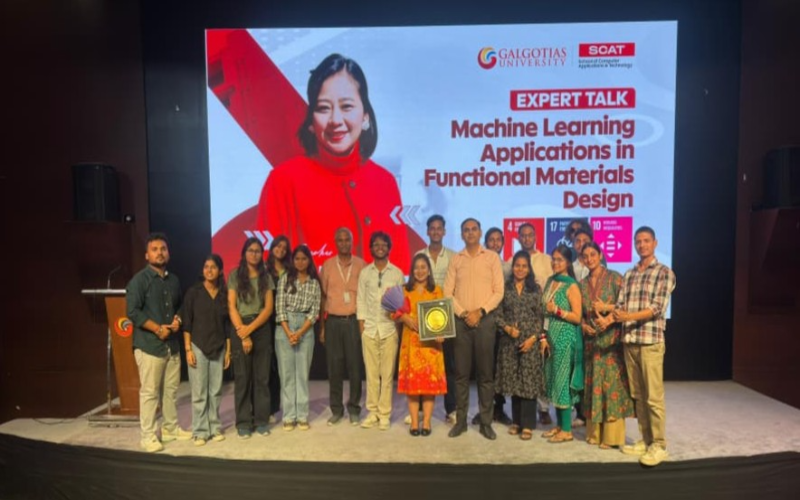
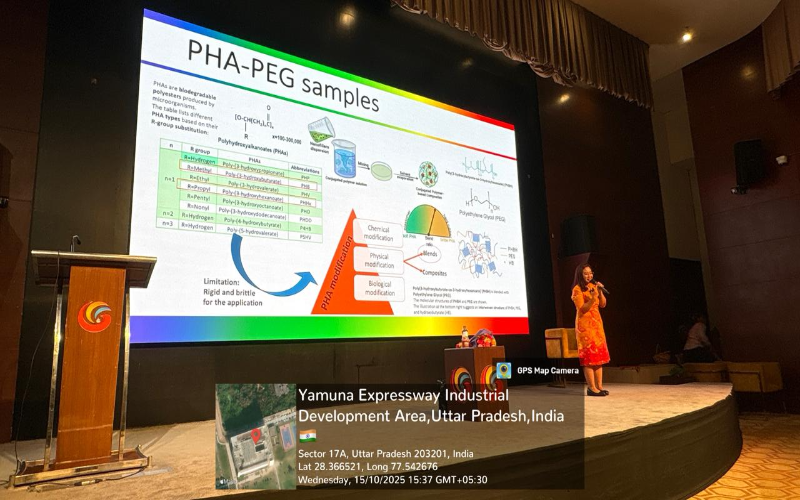
Event brief description –The session aimed to bridge the gap between basic sciences, chemistry, and artificial intelligence, highlighting the role of machine learning (ML) in accelerating research and innovation in material science.Dr. Mega Novita delivered an insightful talk explaining how data-driven models and machine learning algorithms are transforming the process of discovering and optimizing functional materials. She discussed various ML approaches for predicting chemical properties, designing new compounds, and modeling materials’ performance. She emphasized the integration of basic science principles with advanced computational techniques to achieve sustainable and efficient material design. The talk also covered real-world applications of ML in chemical synthesis, energy materials, and nanomaterials. Applications of supervised and unsupervised learning in material prediction. The importance of datasets and feature engineering in chemical sciences. The synergy between chemistry, materials science, and AI-driven modelling. Case studies where ML accelerated materials discovery and performance prediction
Event Detailed Description- The expert talk on “Machine Learning Applications in Functional Materials Design” delivered by Dr. Mega Novita, Associate Professor and Head of International Affairs, Universitas PGRI Semarang, Indonesia, focused on bridging the gap between basic sciences, chemistry, and artificial intelligence (AI). The session aimed to highlight how the convergence of these disciplines is revolutionizing research and innovation in material science, paving the way for faster, data-driven discoveries and optimized material performance. Dr. Novita began by emphasizing the transformative potential of machine learning (ML) in material science, where traditional experimental approaches are often time-consuming and resource-intensive. By leveraging data-driven models and computational intelligence, researchers can now predict material properties, design new compounds, and simulate performance before conducting actual experiments. This not only accelerates the research process but also minimizes costs and environmental impact. The talk provided an overview of various ML approaches used in the field, such as supervised and unsupervised learning techniques. In supervised learning, models are trained using labeled datasets to predict specific material properties like conductivity, elasticity, or chemical reactivity. For instance, regression models can estimate melting points or band gaps based on molecular structures. Unsupervised learning, on the other hand, helps in clustering materials with similar characteristics or identifying patterns in large, unlabeled chemical datasets. These approaches are instrumental in discovering new materials with targeted functionalities. Dr. Novita also elaborated on the importance of datasets and feature engineering in chemical sciences. The quality and quantity of data significantly influence the accuracy of ML predictions. She explained that feature engineering—selecting and transforming relevant chemical descriptors—plays a crucial role in enabling algorithms to learn meaningful patterns from molecular structures. With the growing availability of open-source material databases, researchers now have access to vast repositories that support the training of reliable and robust ML models. One of the key highlights of the session was the discussion on AI-driven modeling and simulation. Dr. Novita explained how integrating fundamental principles of physics and chemistry with advanced computational techniques leads to more interpretable and accurate models. This interdisciplinary approach allows scientists to understand not only what materials work but also why they behave in certain ways. Such synergy between basic sciences and AI contributes to the rational design of materials for sustainable applications. The talk also showcased real-world applications of ML in various domains of material science. Examples included the prediction of chemical reaction outcomes, design of energy-efficient materials for batteries and solar cells, and the discovery of nanomaterials with enhanced mechanical and thermal properties. Through several case studies, Dr. Novita demonstrated how ML has successfully accelerated materials discovery and performance prediction, reducing the experimental trial-and-error phase and enabling rapid innovation. In conclusion, the session provided valuable insights into how machine learning is reshaping material science by merging theoretical knowledge with computational intelligence. Dr. Novita’s presentation underscored that the future of material design lies in the seamless integration of chemistry, data science, and artificial intelligence, fostering a new era of sustainable, efficient, and intelligent materials research.
Department Name –SCAT
Event Outcome : SCAT aims to contribute to upholding the standards for educational systems worldwide. With this MoU, the school expects to:
- Strengthened academic partnership between Galgotias University and Universitas PGRI.
- Formalization of the MoU agreement outlining future collaborative initiatives.
- Exchange of research ideas and academic best practices.
- Identification of potential areas for joint research and faculty-student mobility programs.
Related Goal