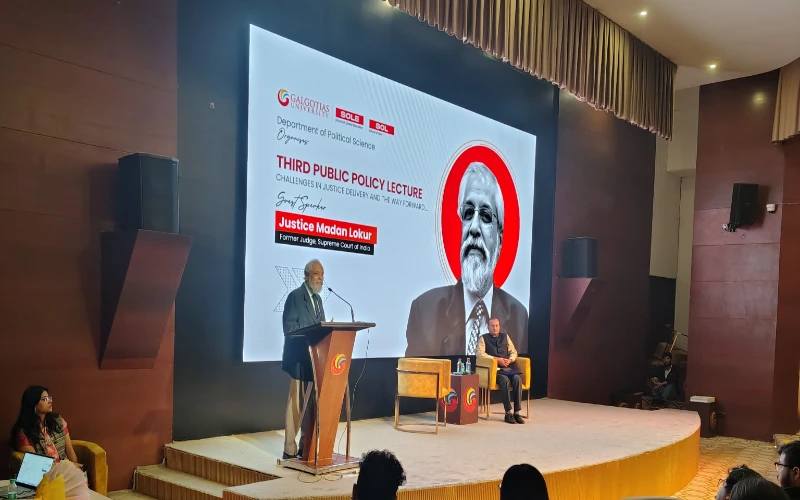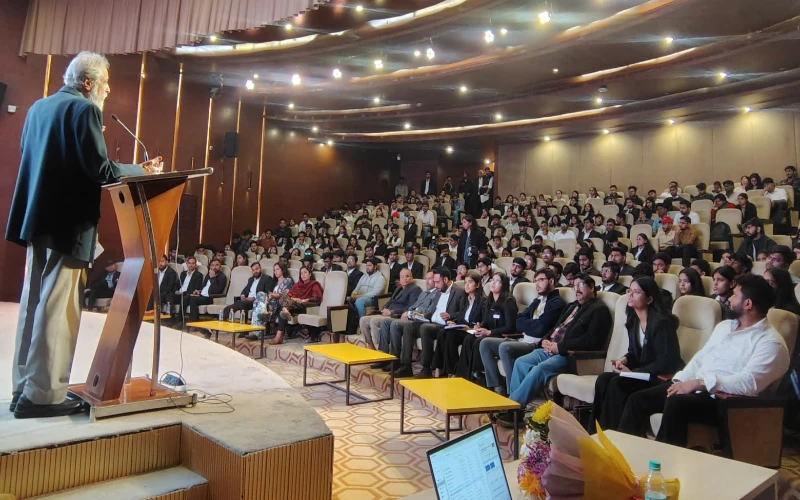
Third Public Polity Lecture: Challenges in Justice Delivery and the way forward by Hon’ble Justice Madan Lokur, Former Judge of Supreme Court of India.
Event Date: 22nd November 2025
Event brief description
The interactive session with Hon’ble Justice Madan Lokur gave us a clear and honest look at the challenges facing the Indian judiciary. He began by comparing the pending cases in 2015 with the situation today. In 2015, the Supreme Court had around 61,000 pending cases. Now the number is close to 90,000. High Courts have seen an increase of almost 20,000 cases within a single month. District courts are carrying an even heavier load with nearly 20 lakh pending matters. He also mentioned that some cases have remained unresolved for more than thirty years. A large part of the problem comes from vacancies, with about 26 percent of posts empty in the High Courts and around 20 percent in district courts.
He referred to the 1987 Law Commission report which said that India needed 50 judges for every million people. With the population now at 1.4 billion, the requirement would be close to 70,000 judges along with sufficient support staff.
Justice Lokur then spoke about the collegium system, the low number of women judges, and his experience in Fiji where judicial deliberations are recorded to promote transparency. He also described the detailed selection process for judges in the United Nations. He ended by stressing the need for stronger implementation of laws, more mediation and plea bargaining, active undertrial review committees, gram nyayalayas, and regular performance audits.
Event Detailed Description
The interactive session with Hon’ble Justice Madan Lokur offered an honest and eye-opening look at the state of the Indian judicial system. He opened the session by drawing a comparison between the volume of pending cases in 2015 and the situation today. In 2015, the Supreme Court had around 61,000 pending cases. Today, that number has climbed to nearly 90,000. He pointed out a similar rise in the High Courts, where the pendency has gone up by almost 20,000 cases in just a month. The district courts, he added, are facing an even heavier burden, with nearly 20 lakh cases pending.
Justice Lokur highlighted that some cases remain unresolved for more than three decades. He also noted that 26% of posts in the High Courts and about 20% in the district judiciary are still vacant. According to him, these numbers reveal the depth of the crisis the system is quietly struggling with.
To put this in perspective, he referred to a 1987 Law Commission report which stated that India needed 50 judges per million people when the population was around 800 million. With the population now at 1.4 billion, the requirement is nearly 70,000 judges to meet the same ratio. He explained that each judge also needs at least seven supporting staff members, which further widens the gap between what the system needs and what it currently has.
After discussing the broader judicial landscape, Justice Lokur moved to the collegium system and the underrepresentation of women in the judiciary. He shared his concerns about how slow progress has been in bringing more women to the bench and how this affects the system’s fairness and legitimacy.
He then shifted to his international experiences, including his role as Attorney General in Fiji. He described how Fiji records judicial deliberations during the appointment process, a practice that brings a greater level of transparency. He also spoke about the judicial appointment process in the United Nations. Applicants must have at least ten years of experience, undergo a written test on legal reasoning and application of law, appear for an interview, and finally face an election. He mentioned that around 397 applications were received recently, and he was surprised to see no applicants from India.
Justice Lokur also highlighted several areas in India where implementation of existing laws is weak. These included the protection of women’s rights, child marriage, workplace sexual harassment, personal liberty violations, fake encounters, and child trafficking. At the same time, he appreciated the progress made in recognising transgender and LGBTQ+ rights.
Towards the end, he focused on solutions. Better implementation of laws, the wider use of plea bargaining, encouraging mediation in civil disputes, strengthening gram nyayalayas, activating undertrial review committees, and conducting performance audits were some of the measures he suggested to improve the system.
Department Name –School of Law
Event Outcome
The session helped students understand the depth of the challenges within the Indian judicial system. Justice Madan Lokur’s explanation of the rising case pendency, long-standing vacancies, and the urgent need for more judges made the issues clearer and more real. His insights on transparency in judicial appointments and the practices followed in other countries encouraged students to think critically about possible reforms. He also highlighted gaps in implementation, especially in sensitive areas like women’s rights and child protection, which added to the sense of responsibility among the audience. Before concluding, he urged students to actively participate in the Nyay Bandhu pro bono scheme so they can contribute to improving access to justice from the very start of their legal careers.