Short-Term Training Program (STTP) on “Introduction to Machine Learning (ML), Deep Learning (DL), and Generative AI (GenAI)”
Event Date and year:
- Total Duration: 30 contact hours,
- Days: Week-offs (Sundays & Mondays)
- Dates: 21–22 September, 28–29 September, and 23-24 November 2025.
- Daily Duration: 5 hours (Two sessions of 2.5 hours each, with a 1-hour lunch break)
Event brief description
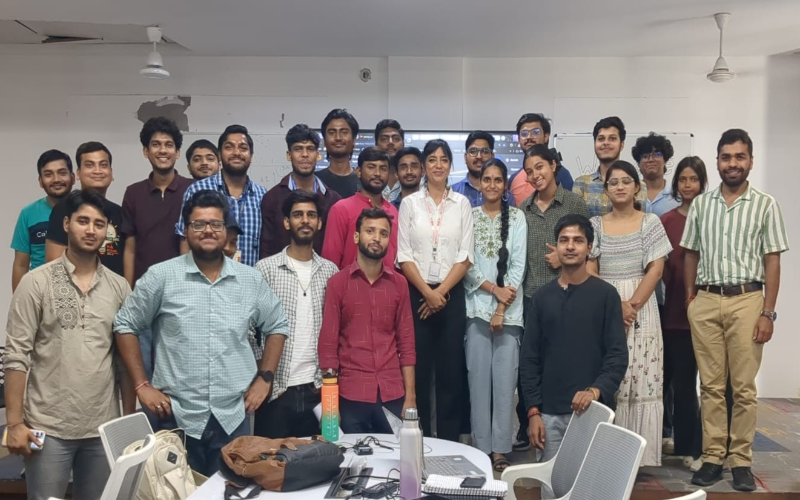
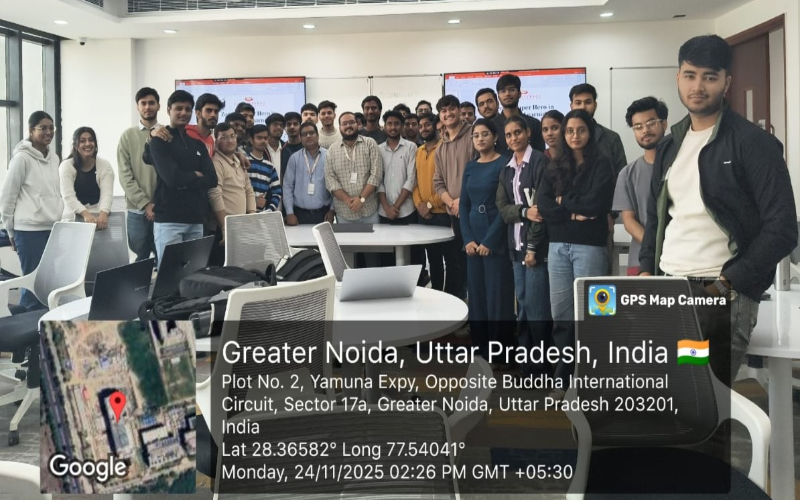
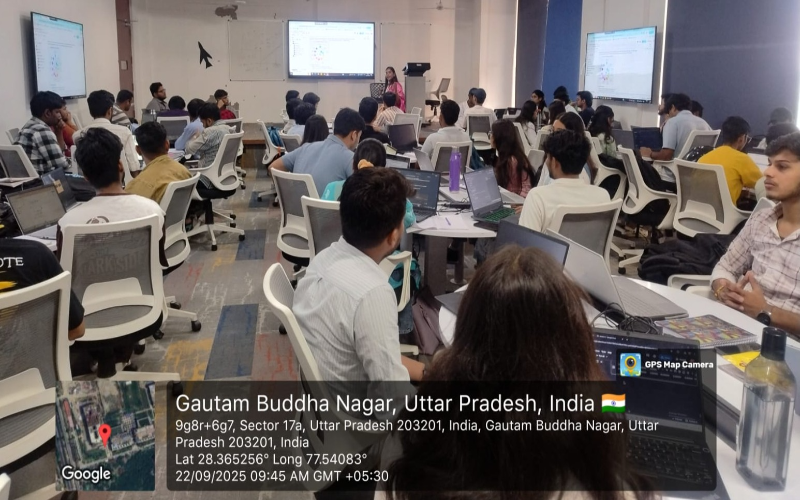
The Department of Artificial Intelligence and Machine Learning, School of Computer Science and Engineering, organized a 30-hour hands-on Short-Term Training Program (STTP) on “Introduction to Machine Learning (ML), Deep Learning (DL), and Generative AI (GenAI)”. The program was designed to build a strong conceptual and practical foundation in the core areas of Artificial Intelligence. It comprised six comprehensive sessions conducted by in-house faculty members, with two to three faculty experts serving as resource persons for each session to ensure depth, clarity, and effective knowledge delivery. The curriculum covered essential topics in ML, DL, and GenAI, including supervised and unsupervised learning, core algorithms, neural networks, Convolutional Neural Networks (CNNs), image processing and model evaluation techniques. It also featured an introductory module on Generative AI, focusing on pre-trained models, emerging applications, and key ethical considerations related to responsible AI development. The program emphasized hands-on learning through practical exercises using real-world datasets, project implementations, assignments, quizzes, and interactive coding sessions. Study material, sample datasets, source code, and weekly assignments were provided to support continuous reinforcement of concepts. The STTP aimed to strengthen technical competence, foster innovation, and prepare students for AI-driven competitions, hackathons, and research-oriented initiatives.
Event Detailed Description
The Department of Artificial Intelligence and Machine Learning, School of Computer Science and Engineering, conducted a 30-hour Short-Term Training Program (STTP) on “Introduction to Machine Learning (ML), Deep Learning (DL), and Generative AI (GenAI)”. The program was designed to provide a comprehensive integration of conceptual knowledge, mathematical foundations, and hands-on implementation skills across the major domains of Artificial Intelligence. The STTP was conducted over six structured sessions totalling 30 contact hours on 21–22 September, 28–29 September, and 23–24 November 2025. Each day consisted of two sessions of 2.5 hours each, with a one-hour lunch break.
All sessions were delivered by in-house faculty members, with each session supported by structured learning material including PowerPoint presentations, source code files, datasets or dataset links, assignments, and project-based hands-on exercises, with class materials pre-uploaded for systematic review.
Day 1 was conducted by Dr. Deepa Joshi and Dr. Gaurav Agrawal. The session introduced the historical evolution of AI, including early symbolic systems such as ELIZA and MYCIN, followed by foundational ML paradigms: supervised, unsupervised, semi-supervised, and reinforcement learning. Students worked with a 113,000-row sales dataset in Google Colab, practicing data loading, inspection, summarization, and initial cleaning using Pandas.
Day 2 was led by Dr. Neha Kumari and Dr. Trapti Shrivastava. The focus was on data preprocessing, feature engineering, and visualization. Using the Titanic and Retail Transaction datasets, participants performed missing-value treatment, encoding, standardization, normalization, duplicate removal, and feature derivation. Exploratory Data Analysis was conducted with Pandas, Matplotlib, and Seaborn, including histograms, scatter plots, boxplots, and heatmaps, with assignments emphasizing real-world business insights.
Day 3 covered core ML algorithms and was facilitated by Ms. Garima Pandey, Mr. Tarachand Verma and Ms. Prem Kumari Verma. Students were introduced to Linear Regression, Logistic Regression, K-Nearest Neighbors, and Decision Trees, along with model evaluation metrics such as confusion matrices. Practical exercises used Iris and Employee datasets, enabling participants to train models, interpret outputs, and evaluate performance.
Day 4 was conducted by Dr. Ashwin Perti, Dr. Namrata Kumari and Mr. Mithlesh Yadav. The session explored Neural Network architectures, including neuron models, synaptic weights, bias, activation functions, forward passes, and derivatives for backpropagation. Concepts such as receptive fields and weight sharing were discussed. Hands-on implementations included House Price Prediction and Iris classification using neural networks.
Day 5 focused on Convolutional Neural Networks and image processing, led by Dr. Durgesh Nandini and Mr. Tushar Mehrotra. The session highlighted the limitations of Multilayer Perceptron for high-dimensional image data, introducing convolution operations, pooling, feature extraction, and data augmentation. Participants practiced on TFDS datasets including CIFAR-10, MNIST, flowers, and Cats vs Dogs and many more.
Day 6 was conducted by Dr. K Susheel Kumar and Mr. Sachin Saurabh, covering Generative AI fundamentals, transfer learning, and pre-trained models. Ethical, legal, and societal implications of AI solutions were discussed. Students explored foundation models and their applications in vision and language tasks.
The STTP emphasized project-based, implementation-oriented learning throughout all sessions, enabling participants to develop practical competence, analytical skills, and readiness for advanced AI applications, hackathons, innovation challenges, and research-driven initiatives.
Department Name: Department of Artificial Intelligence & Machine Learning, School of Computer Science and Engineering.
Event Outcome : The STTP achieved the following event outcomes:
Demonstrated comprehensive theoretical understanding of core Machine Learning, Deep Learning, and Generative AI concepts, algorithms, and underlying architectures.
Applied hands-on, implementation-based learning to analyze datasets, build functional models, and develop practical AI solutions through structured project-based activities.
Designed, implemented, and presented AI-driven prototypes aligned with the expectations of hackathons, innovation challenges, and applied research problem statements.
Utilized Python, TensorFlow, and other industry-relevant tools effectively for end-to-end model development, experimentation, and deployment workflows.
Evaluated and addressed ethical, legal, and societal considerations associated with AI applications, ensuring responsible and context-aware solution development.
Related Goal