
DAY 1: “From Constituent Assembly to Constitutional Morality: The Journey of Affirmative Actions in India” by Hon'ble Mr. Justice Uday Umesh Lalit, Former Chief Justice of India.
Event Date: 23rd August 2025
Event brief description
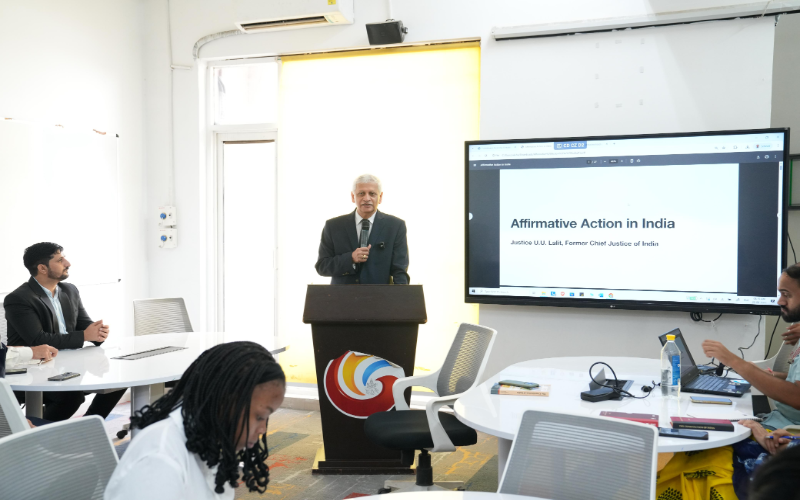
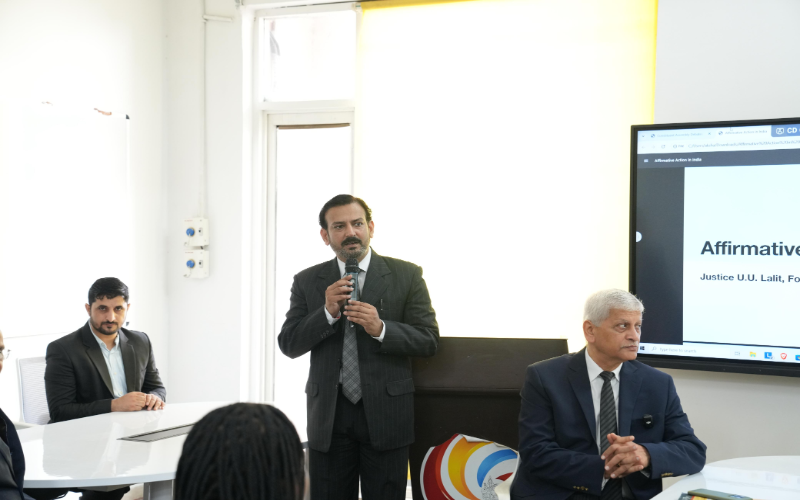
On 23rd August 2025, Galgotias University inaugurated the Masterclass Series titled “From Constituent Assembly to Constitutional Morality: The Journey of Affirmative Actions in India”, to be delivered in full by Hon’ble Mr. Justice Uday Umesh Lalit, Former Chief Justice of India. The inaugural ceremony was graced by Dr. K. Mallikharjuna Babu, Vice Chancellor of Galgotias University, Dr. Aditya Tomer, Dean, School of Law, and Dr. Mudassir Nazir, Convener of the event.
The event marked the first day of the series, beginning with Justice Lalit’s opening lecture that traced the historical roots of affirmative action in India. He highlighted early reformist contributions of Jyotirao Phule and Rajarshi Shahu Maharaj, the Justice Party’s pioneering role in Madras (1921), and the Poona Pact of 1932, which shaped India’s political and social framework.
Justice Lalit emphasized that affirmative action is not only a constitutional safeguard but also a reflection of constitutional morality and social justice. By situating these developments within India’s democratic journey, his lecture provided a solid foundation for the series, which aims to engage students with the evolution, challenges, and contemporary debates surrounding affirmative action in India.
Event Detailed Description
The first day of the Masterclass Series on “From Constituent Assembly to Constitutional Morality: The Journey of Affirmative Actions in India” was held on 23rd August 2025 at Galgotias University, inaugurated by Hon’ble Mr. Justice Uday Umesh Lalit, Former Chief Justice of India. The event began with a formal inaugural session attended by Dr. K. Mallikharjuna Babu, Vice Chancellor, Prof. (Dr.) Aditya Tomer, Dean of the School of Law, and the Convener, Dr. Mudassir Nazir, who welcomed the dignitaries and outlined the vision of the series.
Justice Lalit, delivering his first lecture in the series, traced the historical development of affirmative action in India. He began with Jyotirao Phule’s 1881 representation to the Hunter Commission and Rajarshi Shahu Maharaj’s 1902 reservation policy in Kolhapur, which laid the groundwork for social justice in modern India. He then highlighted colonial interventions such as the Miller Committee Report (1919) and the Justice Party’s historic reservation policy in Madras (1921).
A central theme of his lecture was the Poona Pact of 1932, an agreement between Dr. B.R. Ambedkar and Mahatma Gandhi, which reshaped the representation of marginalized communities and laid a foundation for constitutional safeguards. Justice Lalit explained how these early milestones culminated in the Indian Constitution of 1950, where the framers institutionalized affirmative action as a means to achieve substantive equality and social justice.
The lecture also examined the judicial evolution of affirmative action, beginning with State of Madras v. Champakam Dorairajan (1951) and moving through landmark judgments like Indra Sawhney v. Union of India (1992), which refined doctrines such as the 50% ceiling rule and the creamy layer principle. Justice Lalit further touched upon contemporary debates, including the 103rd Constitutional Amendment (2019) introducing reservations for the Economically Weaker Sections (EWS).
Throughout his address, Justice Lalit stressed that affirmative action is both a historical necessity and a moral imperative, rooted in constitutional morality. He urged students to recognize the Constitution as a living document, one that evolves through struggles for equality and justice.
The inaugural day concluded with an interactive session, allowing students and faculty to reflect on the day’s insights. The presence of the Vice Chancellor, the Dean, and the Convener emphasized the University’s commitment to fostering academic spaces where constitutional values are critically examined.
This first day of the Masterclass Series set a powerful intellectual foundation, ensuring that subsequent sessions will further deepen engagement with one of the most vital themes of India’s constitutional journey.
Department Name – School of Law
Event Outcome
The inaugural session of the Masterclass Series proved to be an intellectually enriching experience for students and faculty alike. Justice U.U. Lalit’s lecture offered a comprehensive understanding of the historical and constitutional foundations of affirmative action, linking early reformist efforts with contemporary legal developments. The event fostered critical awareness of the role of constitutional morality in shaping social justice, encouraging students to reflect on the Constitution as a living, evolving framework. The strong participation and interactive discussions highlighted the success of the opening day and set a promising tone for the subsequent sessions in the series.

Related Goal