
DAY 5- “From Constituent Assembly to Constitutional Morality: The Journey of Affirmative Actions in India” by Hon'ble Mr. Justice Uday Umesh Lalit, Former Chief Justice of India.
Event Date and year: 20th September 2025
Event brief description
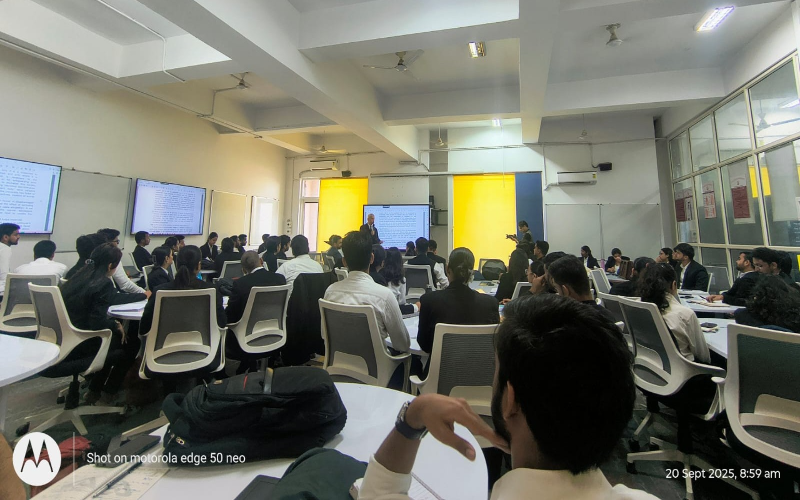
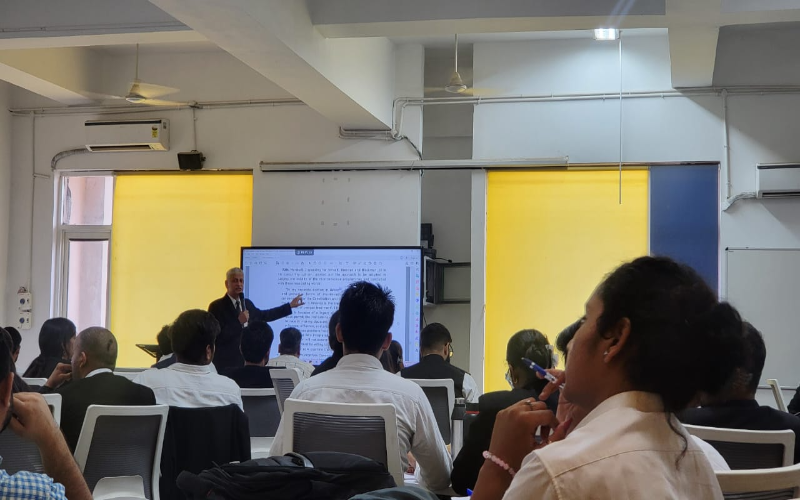
The fifth day of Justice U.U. Lalit’s Master Class focused on comparative perspectives on equality in educational admissions. Continuing his discussion on Indra Sawhney v. Union of India, Justice Lalit examined how the judgment referred to U.S. constitutional cases on affirmative action and equality. He traced the evolution of U.S. jurisprudence, beginning with Plessy v. Ferguson (1896), where segregation was initially viewed as consistent with equality, and Brown v. Board of Education (1954), which overturned that view by declaring segregation in public schools unconstitutional. Justice Lalit also highlighted Regents of the University of California v. Bakke (1978), which allowed diversity as a goal without fixed quotas, and Grutter v. Bollinger (2003), where Justice Sandra Day O’Connor upheld narrowly tailored affirmative action policies for law school admissions.
He noted how universities such as Harvard sought a “diverse student body” as a legitimate aim, but subsequent concerns arose over outsiders occupying a significant proportion of admissions. The recent Students for Fair Admissions v. Harvard (2023) judgment rolled back affirmative action, holding that race-conscious admissions violated the U.S. Constitution’s Equal Protection Clause. Justice Lalit compared this trajectory with Indian precedents like Champakam Dorairajan, underlining the balance between equality and social justice.
Event Detailed Description
On the fifth day of his Master Class, Justice U.U. Lalit continued his in-depth conversation on the landmark Indian case Indra Sawhney v. Union of India, focusing particularly on its implications for admissions to educational institutions. Building on previous discussions about reservations and equality, Justice Lalit examined how the judgment drew on comparative constitutional law, especially from the United States.
He began by reflecting on the shared phrase “We, the People” in both the U.S. and Indian Constitutions, noting how each nation’s understanding of equality has evolved. In the U.S., segregation was once considered compatible with equality, as seen in Plessy v. Ferguson (1896). This position was fundamentally overturned by the U.S. Supreme Court in Brown v. Board of Education of Topeka (1954), which unanimously ruled that racial segregation in public schools was unconstitutional, declaring that “separate educational facilities are inherently unequal.”
Justice Lalit then discussed Regents of the University of California v. Bakke (1978), which introduced the idea that a “diverse student body” could be a compelling goal for universities, even while prohibiting rigid quotas. He examined Harvard’s approach to fostering diversity, explaining how it became a benchmark for race-conscious admissions. The conversation moved to Grutter v. Bollinger (2003), where Justice Sandra Day O’Connor upheld the University of Michigan Law School’s affirmative action policy as narrowly tailored to achieve diversity, while cautioning that such measures should not continue indefinitely.
Justice Lalit highlighted social concerns that arose when significant proportions of admissions at elite U.S. universities were perceived as being taken by outsiders, leading to debates about their representation in influential professions while native-born citizens were relegated to manual jobs. This tension resurfaced in Students for Fair Admissions v. Harvard (2023), where the U.S. Supreme Court ruled that Harvard and the University of North Carolina’s race-conscious admissions programs violated the Fourteenth Amendment’s Equal Protection Clause, effectively dismantling affirmative action in higher education.
Drawing parallels, Justice Lalit compared these developments to Indian constitutional jurisprudence, particularly State of Madras v. Champakam Dorairajan, which shaped India’s early approach to reservations in education. He observed that both countries wrestle with the same essential dilemma: how to balance the constitutional guarantee of equality with the need for social justice and inclusion.
The session offered participants a rich understanding of how comparative legal analysis deepens appreciation of constitutional principles. Justice Lalit’s nuanced exploration showed that while contexts differ, the core challenge—ensuring equal opportunity while addressing structural disadvantages—remains universal. The discussion ended with reflections on the continuing relevance of affirmative action debates in shaping equitable access to education.
Department Name – School of Law
Event Outcome
The fifth day of Justice U.U. Lalit’s Master Class enabled participants to gain a deeper understanding of affirmative action and equality in education through a comparative constitutional lens. Attendees appreciated how Indian jurisprudence, particularly Indra Sawhney, aligns and contrasts with U.S. decisions such as Brown, Bakke, Grutter, and Students for Fair Admissions. The discussion clarified the evolving rationale for diversity, quotas, and merit in admissions, while situating these debates within the broader constitutional promise of equality. The session enriched legal scholarship and equipped participants with nuanced perspectives to engage critically with policies on reservations and inclusion.
Related Goal