
DAY 2: “From Constituent Assembly to Constitutional Morality: The Journey of Affirmative Actions in India” by Hon'ble Mr. Justice Uday Umesh Lalit, Former Chief Justice of India.
Event Date: 30th August 2025
Event brief description
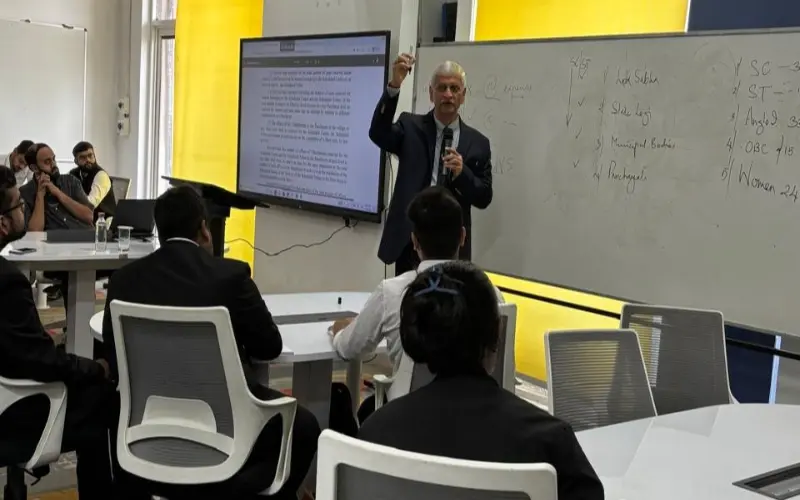
Day 2 of Justice U.U. Lalit’s lecture series opened with a question on his dissent in Janhit Abhiyan (2022) concerning the 10% reservation for Economically Weaker Sections (EWS). Justice Lalit clarified that India’s Constitution is “color conscious”, designed to remedy historic disadvantage, unlike the “color blind” U.S. model. He stressed that reservation benefits should not be monopolized by advanced sections within disadvantaged groups, recalling E.V. Chinnaiah (2005) and its overruling in State of Punjab v. Davinder Singh (2024).
On EWS, he noted that these groups are neither socially nor educationally backward, and their issues are better addressed through scholarships and temporary support rather than structural reservations.
Tracing reservation jurisprudence, he referred to T. Devadasan, Indra Sawhney (1992) on the 50% ceiling, creamy layer, and promotion bar, followed by constitutional responses such as the 77th and 81st Amendments. In education, he highlighted Unnikrishnan, TMA Pai, P.A. Inamdar, and the 93rd Amendment, which allowed reservations in private institutions.
The session concluded with references to the 103rd Amendment (EWS) and the 106th Amendment (women’s reservation), underscoring the evolving framework of affirmative action under the Constitution.
Event Detailed Description
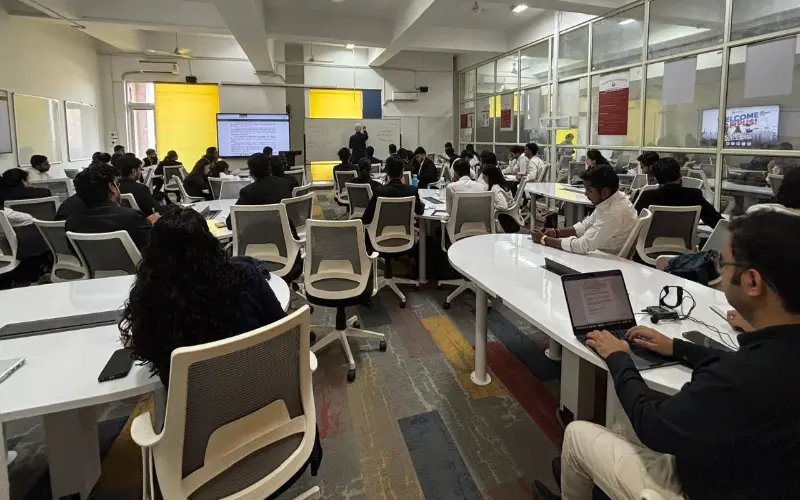
The second day of Justice U.U. Lalit’s lecture series opened with a round of questions from participants in the previous session. The discussion began with a query on his dissenting opinion in Janhit Abhiyan (2022), which upheld the 10% reservation for Economically Weaker Sections (EWS).
Justice Lalit explained that affirmative action in India must be understood in the context of the Constitution being “color conscious”, unlike the U.S. Constitution which is often described as “color blind.” He highlighted that affirmative action cannot be at the expense of fellow citizens, as this leads to the benefits being cornered by the most advanced layers of disadvantaged communities. Referring to E.V. Chinnaiah v. State of Andhra Pradesh (2005), he discussed why some advantaged sections within Scheduled Castes should not indefinitely continue to claim benefits. He stressed that while progress has been made since the 1940s, significant ground remains, and the goal is not simply redistributing the existing share but expanding opportunities—“increasing the size of the cake.”
On EWS reservations, he observed that this group is neither socially nor educationally backward. Individual economic hardships, he explained, should not be equated with structural disadvantages faced by historically marginalized communities. He described EWS reservations as a transient measure, better addressed through scholarships and support schemes rather than permanent structural reservations.
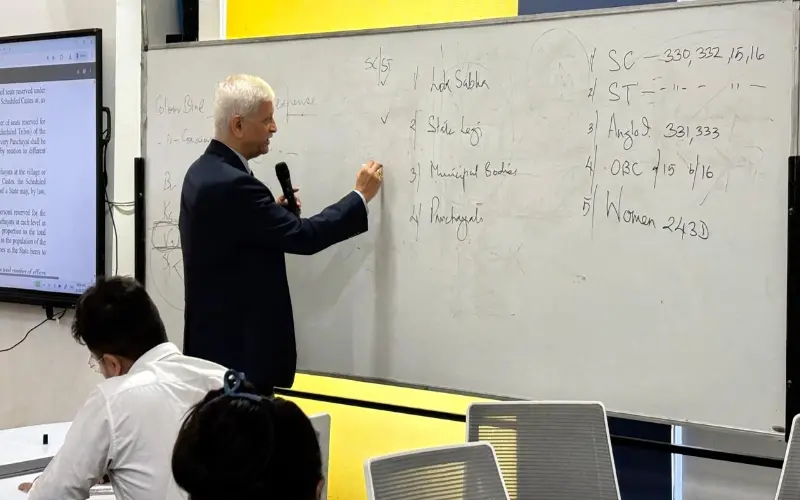
Justice Lalit then traced the constitutional evolution of reservation jurisprudence. Starting with T. Devadasan v. Union of India, he recalled Justice Subba Rao’s interpretation that Article 16(4) is not an exception to Article 16(1) but a distinct enabling provision to ensure substantive equality. This reasoning was later reaffirmed in Indra Sawhney (1992), authored by Justice B.P. Jeevan Reddy, which upheld caste as a valid marker of backwardness, introduced the 50% ceiling, barred reservations in promotions, and mandated exclusion of the creamy layer from OBC benefits. The judgment distinguished between entry-level access and career progression, while allowing five years for administrative restructuring.
To counter the limitation on promotions, Parliament enacted the 77th Amendment, introducing Article 16(4A) to restore reservation in promotions for SCs and STs. Later, the 81st Amendment (2000) added Article 16(4B), allowing carry-forward of unfilled reserved vacancies beyond the 50% cap.
In education, Justice Lalit discussed Unnikrishnan v. State of Andhra Pradesh (1993), which recognized free and compulsory education as part of the right to life under Article 21. Subsequent cases—TMA Pai Foundation (2002) and P.A. Inamdar (2005)—clarified the rights of private institutions and minorities, affirming autonomy under Articles 19(1)(g) and 30 while permitting state regulation to ensure fairness. In response, Parliament passed the 93rd Amendment (2006), inserting Article 15(5) to allow reservations in private educational institutions, excluding minority-run institutions.
He also reviewed cases on state-specific recognition of SC/ST status. In Marri Chandra Shekhar Rao (1990), the Court held that Scheduled status is state-specific, a view reiterated in later rulings. However, in Bir Singh v. Delhi Jal Board (2018), the Court recognized Delhi’s peculiar Union Territory status, permitting pan-India recognition.
The session concluded with recent constitutional developments: the 103rd Amendment (2019) introducing EWS reservations, the 106th Amendment (2023) providing women’s reservation in legislatures, and the State of Punjab v. Davinder Singh (2024), where a seven-judge bench overruled Chinnaiah and upheld sub-classification within SCs to ensure equitable distribution of benefits. Justice Lalit noted that upcoming sessions would further explore comparative constitutional perspectives.
Department Name – School of Law
Event Outcome
The second day of Justice U.U. Lalit’s lecture series focused on reservations and constitutional equality. Responding to a question on Janhit Abhiyan (2022), he explained why EWS reservations differ from caste-based reservations, stressing that economic hardship is not the same as social disadvantage. Tracing landmark cases like Devadasan, Indra Sawhney, and Unnikrishnan, he highlighted how the Constitution balances equality with affirmative action. He also discussed amendments on promotions, private education, and women’s reservation, as well as the Davinder Singh (2024) ruling allowing sub-classification within SCs. The session ended with a promise of comparative constitutional insights in upcoming lectures.
Related Goal